My Data Governance Tool Market Guide (2026)

    Compare 42 data catalog, data lineage, and data governance tools: how to choose one, what changed in 2026, key features, and public pricing.

    By Ari Bajo - Data Engineer turned Writer.

    Updated on November 5, 2026

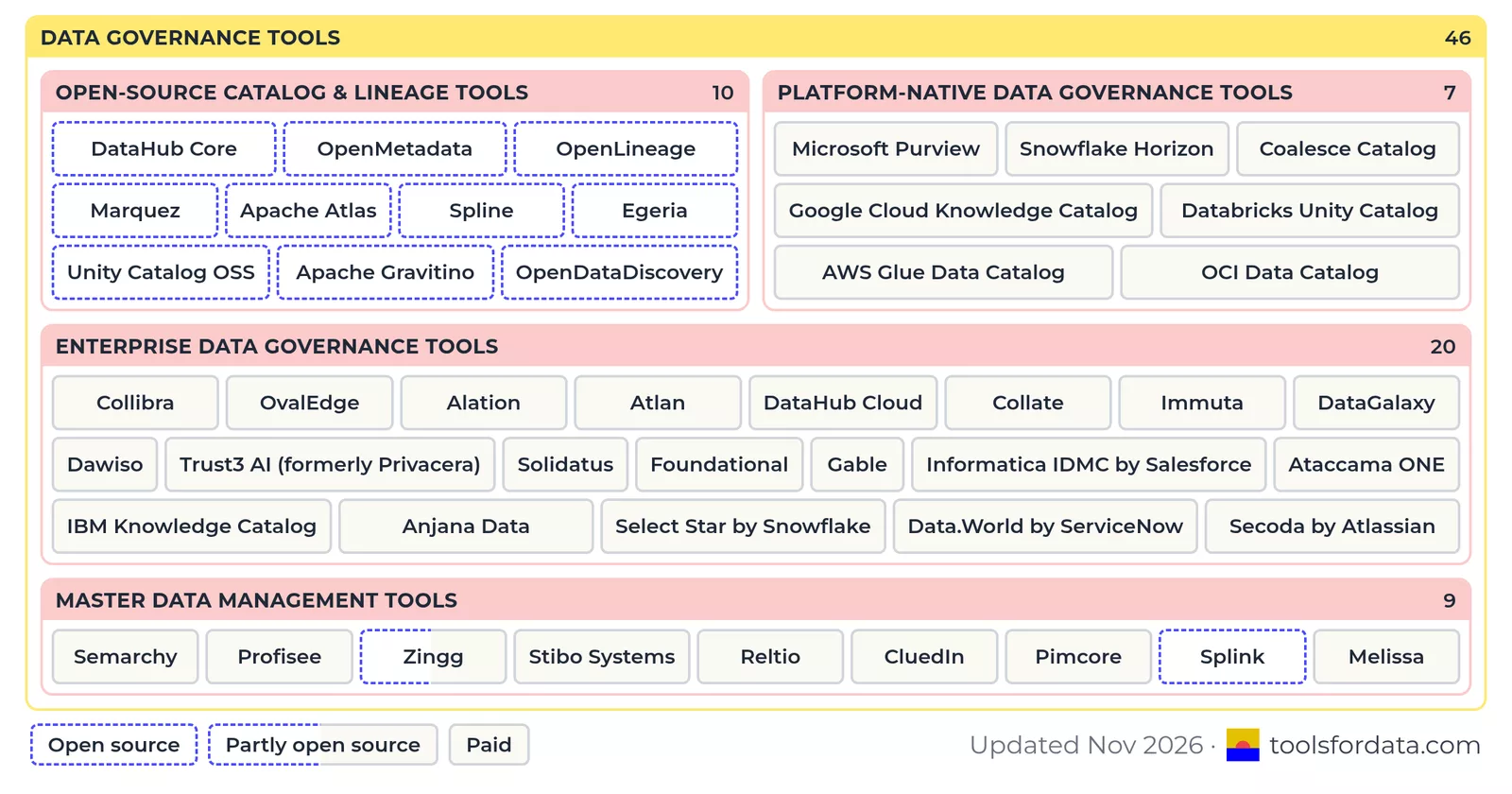
    Data governance tools market landscape, November 2026: 45 tools across open-source catalog and lineage, enterprise, platform-native, and master data management tools
    Click to enlarge

    Data governance used to be a compliance project: a catalog, a glossary, and a steward chasing owners for descriptions. In 2026, almost every vendor sells something else. Atlan calls itself "the context layer for AI". DataHub is "The Context Platform for AI Agents". Collibra promises "Governed context. Certain AI." Google renamed Dataplex to Knowledge Catalog, "an always-on context engine".

    The pitch changed because the buyer changed. AI agents need to know what a table means, who owns it, and whether they're allowed to use it, and that's exactly what a catalog stores.

    There are now 46 tools on my data governance tools list. This guide is for data teams deciding whether they need a data governance tool, and which one. It covers what a data governance tool is, the market in 2026, what changed this year, whether you need a tool at all, how to choose, the features that actually separate tools, and pricing.

    What Is a Data Governance Tool?

    A data governance tool tells you what data you have, what it means, who owns it, and who is allowed to use it. In practice, that means four jobs, and most tools are strong at two of them.

    Finding and explaining data. A data catalog harvests metadata from your warehouses, pipelines, and BI tools, and adds descriptions, a business glossary, and certification so people (and now AI agents) know which table to trust.

    Tracing where data comes from. Data lineage maps how data flows from source to dashboard, so you can see what breaks before you change a column and where a bad number came from.

    Making someone responsible. Data stewardship assigns owners and stewards, routes changes through approval workflows, and runs campaigns to fill in what is missing.

    Controlling access. Data classification finds PII and sensitive data and tags it, so masking and access policies follow the tags instead of being written table by table.

    A data governance tool is not a data quality tool, though the two keep merging. Governance tools describe and control data; data quality tools check that its values are right. And keeping one trusted record per customer or product is a separate job, for master data management tools.

    The Data Governance Market in 2026

    I group the 46 tools on my list into four segments.

    Open-source catalogs and lineage (10 tools)

    DataHub Core, OpenMetadata, OpenLineage, Marquez, Apache Atlas, and others. You self-host them, and most have a managed version from the company behind them: DataHub Cloud and Collate. This is where most data teams start, and where the fastest product work happens.

    Enterprise data governance (21 tools)

    Collibra, Alation, Atlan, Informatica, Ataccama ONE, and others. Built for business users and data stewards, with glossaries, workflows, and policies. This year, almost all of them repositioned around AI agents.

    Platform-native data governance (6 tools)

    Microsoft Purview, Databricks Unity Catalog, Snowflake Horizon, Google Cloud Knowledge Catalog, AWS Glue Data Catalog, and OCI Data Catalog. Governance built into the platform you already pay for. This is the segment that moved the most in 2026: every one of them added business context on top of technical metadata.

    Master data management (9 tools)

    Semarchy, Profisee, Reltio, Stibo Systems, CluedIn, the source-available Pimcore, and the open-source Zingg and Splink, plus Melissa for contact data matching. They match and merge records into golden records that stewards curate. It's a separate buying decision, and only Informatica and Ataccama ONE cover it inside a governance suite.

    What Changed in the Last 12 Months

    I compared each vendor's homepage today with its November 2025 version and read a year of release notes. My summary: data governance vendors stopped selling governance.

    Everyone sells context for AI

    Atlan dropped "active metadata" for "the context layer for AI". DataHub went from "AI & Data Context Management" to "The Context Platform for AI Agents". OpenMetadata replaced "discovery, observability, and governance" with "open context platform for humans, AI assistants, and agents". Snowflake Horizon now harvests metadata from 18 external sources (preview, October 2026). My read: the product didn't change as much as the buyer did. A catalog was always context; now agents read it.

    Catalogs started governing agents, not just data

    Collibra launched an AI Command Center (May 2026) and Guardian Agents that can block agent actions outside policy (private preview). Alation launched AI Governance (May 2026) and rebuilt itself as an "operating system for enterprise AI". DataHub Cloud added an agent registry. In my matrix, 12 of 20 tools now keep an inventory of AI models and agents.

    Big names were acquired

    Salesforce closed its ~$8 billion acquisition of Informatica (November 2025). Atlassian bought Secoda (December 2025) and Snowflake bought Select Star (announced November 2025). Collibra bought trail ML for AI compliance (October 2026), and Snowflake Ventures invested in Ataccama (December 2025).

    Acquired products went quiet

    Secoda's and Select Star's homepages are the same as a year ago, apart from a banner about their new owners, and I found no new releases since the deals. My read: if you're evaluating either, ask for the roadmap in writing.

    Platforms added a business layer

    Databricks gave Unity Catalog domains, certification, metric views, attribute-based access control (GA April 2026), and access requests (GA October 2026). Snowflake made certification tags and OpenLineage lineage generally available. AWS added a glossary and semantic search to the Glue Data Catalog (preview). Microsoft Purview is the exception: it stayed security-first, with most releases in data loss prevention and AI app protection.

    MCP is table stakes

    17 of the 20 tools in my matrix ship an MCP server, so your own agents can query the catalog. The question is no longer whether a tool has an AI assistant, but whether your agents can use its context.

    AI regulation arrived, slowly

    Only 4 of 20 tools offer built-in assessments for the EU AI Act, NIST AI RMF, or ISO 42001: Collibra, Alation, Microsoft Purview, and Collate. Everyone else talks about AI governance on their homepage, but stops at inventory.

    Do You Need a Data Governance Tool?

    You probably don't need a dedicated tool if your data lives on one platform and its native catalog covers search, lineage, and access control. Unity Catalog, Snowflake Horizon, and Google Cloud Knowledge Catalog all do that now, at no extra license cost or close to it.

    You need one when your data spans several platforms, when business users can't find or trust data without asking an engineer, when AI agents need governed context across systems, or when a regulator asks you to prove who accessed what.

    My rule: don't buy a catalog to start documenting. Buy one when the questions "what is this table?" and "can I use it?" already cost you hours every week.

    How to Choose a Data Governance Tool

    Most teams should start with what their platform already includes, and buy when they outgrow it. Here are the six situations I see most often.

    You're all-in on one data platform

    Start with the native catalog: Databricks Unity Catalog, Snowflake Horizon, Google Cloud Knowledge Catalog, or Microsoft Purview. Unity Catalog and Horizon are included in the platform editions most teams already pay for. Buy a separate tool when you need lineage and governance across platforms. My take: start here, it's the cheapest way to learn what you actually need.

    You want open source

    Self-host DataHub Core or OpenMetadata. Both are Apache 2.0, have 100+ connectors, and ship lineage, a glossary, and an MCP server. Both have a managed version when you don't want to run them: DataHub Cloud and Collate. Collate has the most generous free plan I found (5 users, 500 assets).

    You need AI agents to use governed context

    Look at Atlan, DataHub Cloud, Collate, and Collibra, which rebuilt their products around context for agents. Ask for a demo with your own agent through their MCP server, not their chat assistant.

    You're a large enterprise with many stewards

    Collibra, Alation, and Informatica are built for governance programs with workflows, approvals, and stewardship campaigns. Budget: their published AWS Marketplace prices range from $60,000 to $170,000 a year. I wouldn't buy one until you have stewards who will use the workflows.

    You're regulated, or privacy is the main driver

    Microsoft Purview leads on data security and compliance: data subject rights, retention, activity monitoring. Collibra, Alation, and Collate add AI regulation assessments. OvalEdge covers records of processing activities (RoPA). Here, the compliance reports are usually what you're really buying, not the catalog.

    You need master data management

    Use a dedicated MDM tool such as Semarchy, Profisee, or Reltio, or a suite that includes MDM: Informatica or Ataccama ONE. They are the only two of the 20 tools in my matrix with golden record management.

    The Questions That Separate Tools

    Almost every tool now covers the basics. In my matrix of 20 tools, 19 or more support search, automated metadata harvesting, AI search, table and column lineage, impact analysis, a business glossary, audit trails, RBAC, SSO, and an API. Don't spend demo time on those.

    These are the features where tools differ. Pick the ones that match your stack and use case, and ignore the rest:

    QuestionTools (of 20)Examples
    Can you self-host it?12DataHub Core, OpenMetadata, Collate
    Does it enforce policies in your platform?7Collibra, Informatica, Collate
    Can it mask sensitive data?11Purview, Unity Catalog, Snowflake Horizon
    Does it support data contracts?8DataHub, OpenMetadata, Atlan
    Does it manage semantic models?7Unity Catalog, Snowflake Horizon, Atlan
    Does it support OpenLineage?11DataHub, OpenMetadata, Snowflake Horizon
    Does it inventory AI models and agents?12Collibra, Alation, DataHub Cloud
    Does it assess AI regulation (EU AI Act)?4Collibra, Alation, Purview
    Does it manage golden records (MDM)?2Informatica, Ataccama ONE

    See every feature in the feature comparison.
    Join the monthly newsletter

    Evaluating data tools in 2026?

    I curate the most comprehensive lists of data tools, up-to-date comparison tables, and actionable market guides for data teams. More useful than a Gartner report. More reliable than asking AI. Next up: Data Governance, Data FinOps, Data Orchestration...

    No spam. Unsubscribe anytime.

    By Ari Bajo - Data Engineer turned Writer.

    Data Governance Tool Features

    The feature comparison covers 74 features across 15 groups. Here is what I learned mapping them.

    Metadata harvesting is solved, context is not

    Every tool scans schemas, tables, and dashboards automatically. The differences are in what gets added on top: business definitions, certification, semantic models, and usage. Only 11 of 20 tools show usage and popularity, which is still the fastest way to know which table people actually trust.

    Lineage is universal, OpenLineage is not

    19 of 20 tools show column-level and end-to-end lineage, mostly parsed from SQL and query logs. Only 11 accept OpenLineage events, the open standard for runtime lineage from Airflow, Spark, and dbt. If your pipelines run outside the warehouse, check this first.

    Policies are defined everywhere, enforced in few places

    16 of 20 tools let you define data policies, but only 7 push them down so the platform enforces them. Everywhere else, the policy is documentation. Platform-native catalogs enforce access by design, which is their strongest argument.

    Classification is common, masking less so

    15 of 20 tools detect sensitive data such as PII, but only 11 can mask it. Some tools only hide columns in their own previews, which doesn't protect the warehouse. Ask where masking happens.

    Data products went mainstream

    15 of 20 tools package data as products with owners, and 15 support self-service access requests. This is the part of data mesh that stuck: a marketplace where business users find data and ask for access without a ticket.

    Semantic models are the new battleground

    Only 7 of 20 tools manage semantic models or metric definitions, led by Unity Catalog metric views, Snowflake semantic views, Atlan, and DataHub. Open standards like Apache Ossie are pushing catalogs to read and sync these definitions. Whoever owns metric definitions owns the context agents need.

    AI governance mostly stops at inventory

    12 of 20 tools list AI models and agents, and 12 control what data agents can access. But only 4 assess AI regulation, and only Collibra scores model health. Expect this to be the most-marketed and least-delivered feature of 2027.

    MDM is a different product

    Golden records, entity resolution, and hierarchy management show up in only 2 of 20 governance tools: Informatica and Ataccama ONE. If you need MDM, buy MDM. A catalog won't merge your customer records.

    Compliance is mostly Purview

    Records of processing activities, retention policies, data subject rights, and activity monitoring are rare: 1 to 5 tools each, led by Microsoft Purview and Collibra. If GDPR operations are your main use case, start from security and privacy tools, not catalogs.

    Join the monthly newsletter

    Evaluating data tools in 2026?

    I curate the most comprehensive lists of data tools, up-to-date comparison tables, and actionable market guides for data teams. More useful than a Gartner report. More reliable than asking AI. Next up: Data Governance, Data FinOps, Data Orchestration...

    No spam. Unsubscribe anytime.

    By Ari Bajo - Data Engineer turned Writer.

    Data Governance Tool Pricing

    Prices range from free open-source catalogs to enterprise platforms costing $170,000 a year. Platform-native catalogs are mostly included in the platform, or billed by usage. Several vendors now publish list prices on AWS Marketplace.

    Last checked: November 2026. Prices from public pricing pages and AWS Marketplace list prices.

    ToolPricing ModelTeam PriceEnterprise Price
    Microsoft PurviewPer governed asset$0.0165/asset/day + data quality compute—
    Google Cloud Knowledge CatalogPer DCU-hour$0.06/DCU-hour (+ $2/GiB-month storage)—
    AWS Glue Data CatalogPer object stored$1/100,000 objects/month above 1M—
    Coalesce CatalogPer user + action$150/user/month (+ Transform, Quality)Custom
    IBM Knowledge CatalogCustom—$25,440/year (starting configuration, AWS)
    DataGalaxyPer userCustom$52,000/year (5 contributors, unlimited readers, AWS)
    AlationCustomCustom$60,000/year (AWS)
    DataHub CloudPer userCustom$75,000/year (20 monthly active users, AWS)
    CollatePer user + assetCustom$75,000/year (25 users, 5,000 assets, AWS)
    CollibraCustomCustom$170,000/year (AWS)
    Informatica IDMC by SalesforcePer IPUCustom$131,760/year (120 IPUs/month, AWS)

    Open-source tools

    Apache Atlas, Apache Gravitino, DataHub Core, Egeria, Marquez, OpenDataDiscovery, OpenLineage, OpenMetadata, Spline, Unity Catalog OSS, Zingg.

    Tools with custom pricing only

    Ataccama ONE, Atlan, Data.World by ServiceNow, OvalEdge, Secoda by Atlassian, Select Star by Snowflake, Snowflake Horizon.

    Platform-native catalogs are the cheapest start

    Unity Catalog and Snowflake Horizon are included in the platform editions, with compute billed separately. Purview charges $0.0165 per governed asset per day. AWS Glue Data Catalog is free for the first million objects. If your data is in one platform, the catalog is close to free.

    Enterprise list prices start around $60,000

    On AWS Marketplace, Alation starts at $60,000 a year, DataHub Cloud and Collate at $75,000, Informatica at $131,760, and Collibra at $170,000. IBM's starting configuration is $25,440. Those are list prices; multi-year contracts get discounts.

    Predictions

    These are my bets for the next two years. Some are already happening; others are calls you can hold me to in the next version of this guide.

    1. "Context" replaces "catalog"

    The word catalog will fade from homepages. Every vendor already sells context, and buyers will judge tools by how well their agents answer questions, not by how many assets they index.

    2. Platform-native catalogs win the mid-market

    Unity Catalog, Snowflake Horizon, and Google Cloud Knowledge Catalog are included, getting better fast, and enforce policies by design. Independent catalogs will need a clear cross-platform story to justify their price.

    3. More acquisitions

    Informatica, Secoda, and Select Star found a parent within a year. Independent catalogs without a platform behind them are next, and acquired products will stop shipping, as Secoda and Select Star already have.

    4. Data quality and governance merge

    I made this call in my data quality tool market guide, and the evidence keeps growing. Collibra, Ataccama, and Collate sell both, and data quality vendors now ship catalogs. Both sell the same thing: data trust, data reliability, or data context, you name it.

    5. AI governance becomes a compliance product

    Today, AI governance mostly means an inventory. With the EU AI Act, buyers will ask for assessments and evidence, and the tools that already do it (Collibra with trail ML, Alation, Purview) will set the bar.

    Conclusion

    The data governance market in 2026 sells context for AI, but the buying decision is still simple. Start with your platform's native catalog. Add an open-source catalog when your data spans platforms. Buy an enterprise tool when you have stewards, workflows, and a compliance program that need it. Then shortlist on the few features that actually separate tools, not on taglines, which changed for almost every vendor this year.

    I don't expect all of these predictions to happen on schedule. But I believe the catalogs that win will be the ones AI agents actually call.

    To compare the tools yourself, start with the tools list and the feature matrix.

    Join the monthly newsletter

    Evaluating data tools in 2026?

    I curate the most comprehensive lists of data tools, up-to-date comparison tables, and actionable market guides for data teams. More useful than a Gartner report. More reliable than asking AI. Next up: Data Governance, Data FinOps, Data Orchestration...

    No spam. Unsubscribe anytime.

    By Ari Bajo - Data Engineer turned Writer.