Tool list · Data quality
My Data Quality Tools List (2026)
Discover the 51 best data quality tools in 2026 (open-source, managed, and platform-native) covering data testing, data observability, shift-left, and unified data quality platforms. The most comprehensive, actionable, and up-to-date list you'll find.
By Ari Bajo - data engineer turned writer.
Updated on November 10, 2026
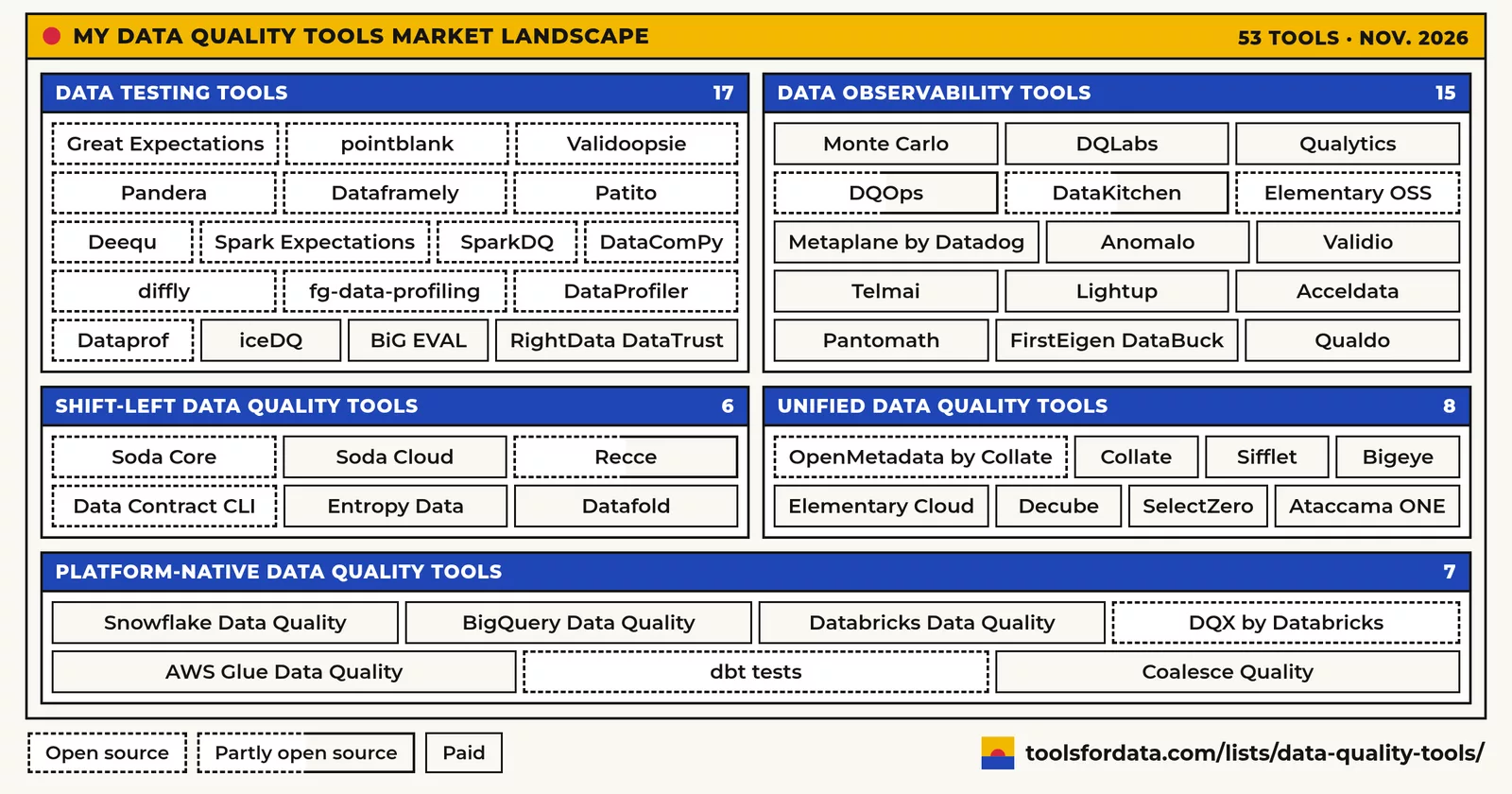
Tools list
Data Observability Tools
Tools focusing on detecting data quality issues with data monitors and anomaly detection.
Monte Carlo
Data + AI observability platform that monitors data pipelines and AI agents in production, with column-level lineage and AI troubleshooting agents.
Best for large data teams ready to invest in a mature, widely adopted platform that monitors both their data and their AI agents.
DQLabs
AI-native platform combining data observability, data quality checks, and business context, with anomaly detection, end-to-end lineage, and pipeline observability.
Best for enterprises that want data quality and observability in one tool, connected to their data catalog and issue management tools.
Acceldata
Autonomous data and AI platform, born in data observability, with AI agents for data monitoring, lineage, governance, and cost optimization.
Best for large enterprises with hybrid or on-premise data estates that want observability, FinOps, and agentic data management from one vendor.
Validio
Agentic data quality and observability platform with real-time validators for streams, lakes, and warehouses, end-to-end lineage, and incident management.
Best for data teams that need real-time anomaly detection on data streams like Kafka and Kinesis as well as in warehouses.
Qualytics
Data quality control layer that validates data where it's used, with checks auto-generated from profiling, anomaly detection, quality context for AI agents, and catalog and MDM modules.
Best for enterprises in regulated industries that need high test coverage without hand-writing rules, and on-premise deployment via Kubernetes.
FirstEigen DataBuck
Context-aware data quality platform that discovers validation rules from your data and reconciles data across platforms.
Best for enterprises in regulated industries that need automated data reconciliations and validations across legacy and cloud sources.
Metaplane by Datadog
End-to-end data observability platform that catches silent data quality issues with ML monitors and column-level lineage to BI dashboards.
Best for modern data stack teams that want monitors running in minutes from the UI, especially if they already use Datadog.
Anomalo
Autonomous data quality monitoring platform where AI agents monitor, investigate, and report issues across structured and unstructured data.
Best for enterprises that want ML-based monitoring with little rule-writing, including quality checks on unstructured data such as documents.
DQOps
Open-source data quality operations center to profile, automate, and monitor data quality with built-in checks, monitors, and data quality KPI dashboards.
Best for data teams that want to customize built-in checks and track data quality KPIs on dashboards. The open-source version has had no releases since January 2026, so prefer DQOps Cloud.
Lightup
Enterprise data observability platform with AI anomaly detection, no-code data quality checks, and an agentic interface that works with Claude and Gemini.
Best for enterprises that want business users to set up no-code checks at scale, with integrations for data catalogs and issue management tools.
Telmai
AI-based data observability platform for data lakes and lakehouses, with continuous data validation, anomaly detection, and data health reports.
Best for data teams monitoring data lakes and lakehouses with native support for Apache Iceberg, Hudi, and Delta Lake.
DataKitchen
Open-source data quality testing and observability suite of two tools, TestGen and Observability, with auto-generated tests, data profiling, and anomaly detection.
Best for cost-conscious data teams that want to start free with Apache 2.0 tools and upgrade to Enterprise, priced per connection and user.
Elementary OSS
Open-source dbt package by Boomi that adds anomaly detection tests and a CLI-generated data observability report to dbt projects.
Best for dbt teams that want free anomaly detection tests inside their existing dbt project, without a cloud account.
Pantomath
AI-powered data operations center with data and pipeline observability, cross-platform pipeline lineage, and automated root-cause analysis.
Best for data operations teams that need to trace failures across pipelines and route incidents to Jira or ServiceNow.
Evaluating data tools in 2026?
I curate the most comprehensive lists of data tools, up-to-date comparison tables, and actionable market guides for data teams. More useful than a Gartner report. More reliable than asking AI. Next up: Data FinOps, MLOps, Data Orchestration...
By Ari Bajo - data engineer turned writer.
Unified Data Quality Tools
Tools combining data quality, data observability, data lineage, and a data catalog in one product.
Sifflet
Data and AI observability control plane with data monitors, end-to-end lineage, a data catalog, and incident management with business context.
Best for data teams that want business users involved in data quality through shared lineage, a catalog, and business-impact alerts.
Bigeye
Enterprise AI trust platform built on data observability, with anomaly detection, end-to-end lineage, and governance of the data AI agents use.
Best for large enterprises with modern and legacy data sources that also need to govern which data their AI agents access.
Elementary Cloud
Data & AI control plane by Boomi with anomaly detection monitors, column-level lineage, incident management, a data catalog, and AI agents.
Best for dbt-centric analytics teams that want managed monitoring, lineage, and AI agents for triage on top of their dbt tests.
OpenMetadata
Open-source context platform that unifies metadata for humans and AI agents, with data discovery, data quality tests, column-level lineage, and governance.
Best for data teams that want one self-hosted, open-source platform for discovery, data quality, and governance with a wide range of integrations.
Collate
Managed agentic data platform built on OpenMetadata, with AI agents, data quality tests, observability metrics, column-level lineage, and governance workflows.
Best for data teams that want OpenMetadata fully managed, with enterprise support, security features, and advanced governance workflows.
Decube
Data observability, quality, and lineage platform that links data monitors to column-level lineage, a data catalog, and access control to show business impact.
Best for data teams that want observability, a data catalog, and data governance in the same tool.
Ataccama ONE
Agentic data trust platform with data quality rules, observability, a data catalog, lineage, master data management, and a built-in AI agent.
Best for large organizations that want enterprise data quality, master data management, and data governance from one vendor.
SelectZero
Self-hosted data observability platform with value-level data validation, column-level lineage, a data catalog, and a business glossary.
Best for enterprises that cannot let data leave their environment and want one self-hosted tool, deployed with Docker.
Evaluating data tools in 2026?
I curate the most comprehensive lists of data tools, up-to-date comparison tables, and actionable market guides for data teams. More useful than a Gartner report. More reliable than asking AI. Next up: Data FinOps, MLOps, Data Orchestration...
By Ari Bajo - data engineer turned writer.
Platform-Native Data Quality Tools
Data quality features built into your data platform or transformation tool, with data tests and data monitors that run where your data already lives.
Databricks Data Quality
Native Databricks data quality: expectations in Lakeflow pipelines warn on, drop, or fail invalid records, and data profiling under Unity Catalog data quality monitoring tracks table metrics and drift over time.
Best for Databricks teams that want data quality rules inside their Lakeflow pipelines and table monitoring in Unity Catalog, without adding a vendor.
Coalesce Quality
Data quality product by Coalesce, built on SYNQ, with UI-based monitors, column-level lineage, and incident workflows next to your transformations.
Best for Coalesce users that want data transformation, a data catalog, and data quality in one product.
Snowflake Data Quality
Native Snowflake data quality checks built on data metric functions (DMFs) and expectations, scheduled per table, with volume and freshness anomaly detection and AI-suggested checks from Cortex Data Quality.
Best for Snowflake teams on Enterprise Edition that want data quality checks without adding a vendor or moving data.
AWS Glue Data Quality
Managed AWS data quality service built on Deequ, with DQDL rulesets, rule recommendations, and anomaly detection for data lakes and Glue pipelines.
Best for teams on AWS Glue Data Catalog and Glue ETL that want to check data at rest and in transit, and quarantine bad records.
BigQuery Data Quality
Google Cloud's managed data quality scans (formerly Dataplex auto data quality) for BigQuery and Iceberg tables, with predefined and SQL rules, rule recommendations from data profile scans, and failed-record queries.
Best for Google Cloud teams that want scheduled data quality rules on BigQuery tables, managed inside their catalog.
dbt tests
Data tests built into open-source dbt Core: generic tests (unique, not_null, accepted_values, relationships), custom SQL tests, and unit tests that run with dbt test, extended by packages like dbt-utils and dbt-expectations.
Best for dbt teams starting with data quality, since tests live next to the models and run in the same CI/CD.
DQX by Databricks
Open-source Databricks Labs framework to validate PySpark DataFrames and tables, with checks generated from profiling and defined in YAML or Python.
Best for Databricks teams validating batch and streaming pipelines who are fine with a Labs project that has no formal Databricks support SLAs.
Evaluating data tools in 2026?
I curate the most comprehensive lists of data tools, up-to-date comparison tables, and actionable market guides for data teams. More useful than a Gartner report. More reliable than asking AI. Next up: Data FinOps, MLOps, Data Orchestration...
By Ari Bajo - data engineer turned writer.
Shift-Left Data Quality Tools
Tools focusing on preventing data quality issues with data contracts, data-diff, and CI/CD.
Soda Core
Open-source data contracts engine (Soda 4) to write data quality checks and contracts in YAML and run them in pipelines and CI/CD.
Best for data engineers who prefer YAML over Python for checks and want them running free inside pipelines and CI/CD.
Soda Cloud
AI-native data quality platform with data contracts written in YAML, UI, or AI, anomaly detection, and AI agents that explain and fix data issues.
Best for data teams that want engineers and business users to agree on data contracts in one place and resolve bad data together.
Data Contract CLI
Open-source command-line tool to lint, test, import, and export data contracts based on the Open Data Contract Standard, maintained by the team behind Entropy Data.
Best for data engineers who want to test data in Snowflake, Databricks, BigQuery, Kafka, and more against ODCS data contracts in CI/CD.
Entropy Data
Data product marketplace (formerly Data Mesh Manager) where every data product has an owner and data contracts based on the Open Data Contract Standard, from the team behind the open-source Data Contract CLI.
Best for organizations adopting data mesh that want a data product marketplace with ODCS data contracts, policy checks, and test results published from the Data Contract CLI.
Datafold
AI-powered data engineering platform with agents for migrations and code reviews, plus data diff, impact analysis, and anomaly detection.
Best for data teams planning a warehouse migration that need value-level proof the migrated tables match the source.
Recce
AI data review agent for dbt pull requests, with open-source data diff, schema diff, downstream impact analysis, and column-level lineage.
Best for dbt teams that want reviewers to see the data impact of code changes before approving a pull request.
Conduktor
Kafka control plane whose Gateway proxy enforces data quality policies before data reaches the brokers, with CEL and JSON Schema rules that block messages or mark them with a violations header.
Best for platform teams that want data quality rules enforced on any Kafka (Confluent, MSK, Aiven, Redpanda, open source) without changing producers.
Confluent Data Contracts
Data contracts for Confluent Schema Registry, where schema rules enforced in Kafka client serializers check messages, for example sending invalid records to a dead letter queue; on Confluent Enterprise and Confluent Cloud with Stream Governance Advanced.
Best for Confluent customers that want data quality rules enforced on Kafka messages at write time, as part of their schemas.
Evaluating data tools in 2026?
I curate the most comprehensive lists of data tools, up-to-date comparison tables, and actionable market guides for data teams. More useful than a Gartner report. More reliable than asking AI. Next up: Data FinOps, MLOps, Data Orchestration...
By Ari Bajo - data engineer turned writer.
Data Testing Tools
Tools focusing on code-based data quality tests and data profiling for SQL tables, files, and DataFrames.
fg-data-profiling
Open-source Python library, formerly ydata-profiling, that turns a pandas or Spark DataFrame into a data quality and exploratory data analysis report in one line, with type inference, alerts, and correlations.
Best for data scientists who want a full profile of a new dataset in one line of code, as a notebook widget or HTML report.
Great Expectations
Open-source Python data quality framework, stewarded by Fivetran, with 50+ declarative expectations to validate files, SQL databases, warehouses, and DataFrames.
Best for Python data engineers who want a free, code-first testing library and don't need a managed UI, since GX Cloud is no longer available.
Pandera
Open-source statistical data testing library from Union.ai to validate pandas, Polars, PySpark, and Ibis DataFrames with Pydantic-style schema classes, built-in and custom checks, and function decorators.
Best for Python data scientists and engineers who want schema checks on DataFrames in their code, across more DataFrame libraries than any other tool.
Deequ
Open-source Spark library from AWS Labs to define data quality constraints, profile columns, and get suggested checks on large datasets.
Best for data engineers running Apache Spark at scale who want unit-test-style data checks in Scala or Python (PyDeequ).
DataProfiler
Open-source Python library from Capital One that loads CSV, JSON, Parquet, Avro, and text files and profiles their schema, statistics, and sensitive data, using a pre-trained model to detect PII.
Best for teams that want profiling and PII detection on raw files in one library, with profiles that merge across batches.
DataComPy
Open-source library from Capital One to compare two DataFrames or tables by join columns in Pandas, Polars, Spark, or Snowpark, with numeric tolerances and a mismatch report.
Best for data engineers validating migrations or refactors who want a free data diff they can run in a notebook or CI.
Patito
Open-source data modelling layer built on Polars and Pydantic, where model classes validate DataFrames with human-readable errors and generate valid mock data for tests.
Best for Python developers who already use Pydantic and want the same models to validate Polars DataFrames.
Dataframely
Open-source Polars-native data frame validation library from QuantCo with declarative schema classes, column and cross-column rules, and validation across collections of related data frames.
Best for Polars teams that want typed, validated data frames between pipeline steps and schema-compliant test data.
pointblank
Open-source data validation framework from Posit to chain validation steps on Polars, Pandas, DuckDB, and SQL database tables, with thresholds, Slack actions, and interactive HTML reports.
Best for analysts and data scientists who want readable validation reports to share, not just pass or fail results.
Spark Expectations
Open-source PySpark data quality framework from Nike that runs row, aggregate, and SQL query rules in-flight with your Spark job, sending failed rows to an error table.
Best for Spark teams that want bad rows split out before they reach the target table, with rules kept in version control.
Validoopsie
Open-source, lightweight data validation library for Python that chains checks on any DataFrame supported by Narwhals, such as pandas, Polars, and PySpark, with impact levels and failure thresholds.
Best for Python developers who want a small, dependency-light validation library that works with whichever DataFrame library they use.
SparkDQ
Open-source, declarative PySpark data quality framework with 30+ built-in row and aggregate checks, defined in Python or as dicts, YAML, or JSON, and run in a single pass in your Spark pipelines.
Best for PySpark teams that want a lightweight, config-driven check library without adopting a platform.
diffly
Open-source utility from QuantCo to compare Polars data frames row by row on primary keys, with per-column match rates, tolerances, and assertion functions for tests.
Best for Polars teams that want a fast, readable diff of two data frames inside their tests and notebooks.
Dataprof
Open-source data profiling library with a Rust core and Python API for CSV, JSON, Parquet, and pandas or Polars DataFrames, with quality scores across seven dimensions and pass or fail gates for CI.
Best for engineers who want fast, local profiling of large files with quality gates in CI.
Evaluating data tools in 2026?
I curate the most comprehensive lists of data tools, up-to-date comparison tables, and actionable market guides for data teams. More useful than a Gartner report. More reliable than asking AI. Next up: Data FinOps, MLOps, Data Orchestration...
By Ari Bajo - data engineer turned writer.
Compare data quality tools
The guide and the comparison tables behind this list.
How I check every fact
I check each feature, integration and price against the vendor's docs, pricing page or GitHub repository, and link the fact to that source.
Vendors and users can send corrections. I verify them against the docs before changing anything, and every page shows when it was last updated.
Spot a mistake? Send a correction →
Frequently Asked Questions
What is a data quality tool?
Why create yet another tools list?
Which data quality tools shut down or were acquired?
- GX Cloud: no longer publicly available since June 2026, after FICO acquired it. The open-source GX Core continues under Fivetran's stewardship.
- Kensu: stopped operating in 2026, after 10 years in data observability.
- Apache Griffin: the open-source project started at eBay is archived.
- Datafold data-diff: the open-source CLI was archived in May 2024; the community continues it as the reladiff fork.
- Google CloudDQ: no active development since 2023; Google calls Dataplex data quality tasks a legacy offering and recommends Dataplex auto data quality.
- DQOps open source: no commits or releases since January 2026. DQOps stays listed for its managed DQOps Cloud version.
- SYNQ: acquired by Coalesce in March 2026 and relaunched as Coalesce Quality.
- Metaplane: acquired by Datadog in April 2025, still sold as Metaplane by Datadog.
- Elementary: acquired by Boomi in October 2026; Elementary OSS and Elementary Cloud remain available.
- IBM Databand: no longer a standalone product; IBM now sells it as the data observability capability of IBM watsonx.data integration.
- Unravel Data: now focused on FinOps and cloud cost optimization.
- Gable and Foundational: now focused on code-level lineage, compliance, and governance, so they are listed with data governance tools.
How can I edit this tools list?
Browse data quality tools by integration
Find the best data quality tools for your stack.